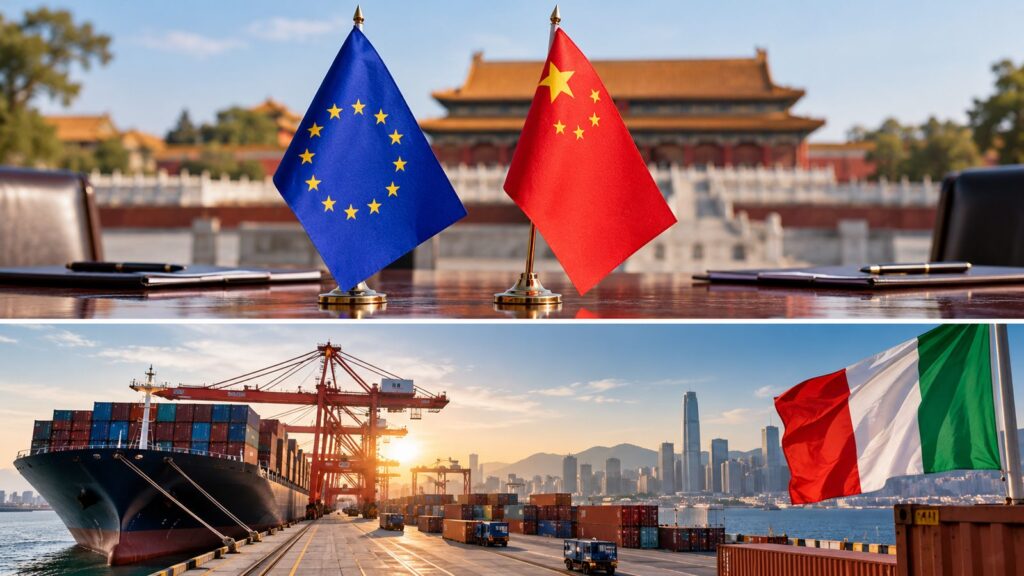
EU-China trade talks are taking the European Union and China towards a more balanced trading relationship. Following high-level consultations held in Beijing on 8–9 October 2026, both sides announced a series of understandings and negotiating outcomes aimed at addressing long-standing commercial disputes and strengthening economic cooperation.
The discussions could have significant implications for Italy, particularly for manufacturers, exporters, importers and businesses operating within global supply chains.
For Italian companies trading with China, the potential consequences extend beyond customs duties. Future developments could affect market access, investment conditions, supply chain stability and international contractual obligations.
But what has actually been agreed, and what could change for businesses operating between Europe and China?
EU-China Trade Talks: What Was Agreed in Beijing?
The latest consultations brought together European Commissioner for Trade and Economic Security Maroš Šefčovič and Chinese Minister of Commerce Wang Wentao.
The meeting marked the second round of EU-China consultations on trade and investment, providing a forum for direct discussions between two of the world’s largest economies.
According to the European Commission’s joint statement of 9 October 2026, the discussions produced several outcomes and understandings, with both parties reaffirming their commitment to addressing trade differences within the framework of World Trade Organization (WTO) rules.
The broader objective is to create a more stable and balanced economic relationship while maintaining channels for cooperation.
Importantly, the two sides also agreed to continue their dialogue through further ministerial-level meetings.
A virtual ministerial meeting is scheduled for January 2027, followed by another round of ministerial consultations in March 2027.
These meetings should provide opportunities to assess progress and address outstanding commercial concerns.
However, the announcement of new understandings does not mean that existing tariffs, import restrictions or other trade barriers have automatically been removed.
Businesses must clearly distinguish political commitments from legally enforceable trade measures.
Why EU-China Trade Relations Matter
China is one of the European Union’s most important trading partners and plays a central role in international manufacturing, logistics and supply chains.
At the same time, significant trade imbalances characterise this relationship. Disagreements over market access, industrial subsidies and regulatory conditions also persist.
According to European Commission trade data, the EU’s trade deficit in goods with China reached approximately €359.9 billion in 2025, compared with €312.2 billion in 2024.
These figures highlight the scale of the economic relationship and the challenges facing European policymakers.
One of the EU’s principal concerns is that European companies do not always enjoy market access conditions comparable to those available to Chinese businesses operating within the European market.
Other issues include industrial support policies, restrictions affecting certain raw materials and technologies, and the protection of intellectual property rights.
The European Union has increasingly sought to reduce strategic economic dependencies while maintaining commercial relations with China.
This approach, often described as de-risking rather than decoupling, seeks to strengthen economic resilience without bringing trade and investment relations to an end.
For further information, the European Commission’s official overview of EU-China trade relations provides background on bilateral trade, market access and ongoing disputes.
What Could the New EU-China Trade Understandings Mean for Italian Businesses?
Italy has substantial economic interests in the relationship between the European Union and China.
Italian companies export industrial machinery, manufactured goods, technology and other products to the Chinese market.
At the same time, many Italian manufacturers depend on components, materials and intermediate goods imported from China.
Changes in bilateral trade conditions could therefore affect production costs, international competitiveness and investment decisions across several sectors.
Automotive and Industrial Components
The automotive industry remains one of the most sensitive areas of EU-China trade relations.
Italian companies specialising in mechanical components, electronics, automotive technology and advanced manufacturing operate within international production networks in which China plays a significant role.
Any changes to trade restrictions, market access conditions or customs duties could affect supply costs and commercial strategies.
Businesses should closely monitor EU trade measures concerning Chinese electric vehicles and related components.
For Italian suppliers, the consequences may extend beyond direct exports to China.
Changes in the competitive position of European and Chinese automotive manufacturers could also influence demand throughout the wider European supply chain.
Industrial Machinery and Manufacturing
Italy has a strong international reputation for industrial machinery, engineering expertise and specialised manufacturing equipment.
Improved access to the Chinese market could create additional opportunities for companies exporting production systems, industrial machinery and advanced technologies.
However, exporting to China involves more than identifying potential customers.
Businesses must also consider technical standards, certification requirements, intellectual property protection and the legal framework governing commercial operations.
Even where political negotiations produce favourable results, companies will still need to verify the specific requirements applicable to their products.
Technology, Raw Materials and Supply Chains
Another critical issue concerns access to raw materials and technological components.
Many European industries depend on international supplies of materials used in electronics, automotive manufacturing, renewable energy systems and advanced industrial processes.
Export restrictions, supply disruptions and regulatory uncertainty can result in higher costs, production delays and difficulties in fulfilling contractual obligations.
For Italian businesses, greater stability in EU-China trade relations could improve the predictability of procurement and investment planning.
Nevertheless, reducing supply chain vulnerabilities remains a significant challenge.
Companies operating internationally may therefore need to assess alternative suppliers, diversify procurement arrangements and review their exposure to geopolitical and regulatory risks.
Tariffs, Trade Barriers and Market Access: What Issues Remain Unresolved?
The October consultations took place against a background of continuing trade disputes between Brussels and Beijing.
Several issues remain central to the relationship, including customs duties, anti-dumping measures, countervailing duties, export restrictions and market access limitations.
Regulatory differences also create challenges for companies trading between the two markets.
An Italian manufacturer exporting products to China may face technical certification requirements, administrative procedures and sector-specific rules in addition to transportation costs and tariffs.
Similarly, an Italian company importing goods from China must ensure that those products comply with applicable European regulations.
Depending on the goods concerned, these may include product safety requirements, conformity assessments, customs procedures and other mandatory obligations.
Removing trade barriers therefore involves more than reducing tariffs. It also requires clearer rules, greater regulatory transparency and more predictable market conditions.
The renewed negotiations offer an opportunity to address these concerns.
However, it would be premature to assume that existing disputes have been resolved or that businesses can immediately benefit from more favourable trading conditions.
International Commercial Contracts: What Should Italian Companies Consider?
The evolution of EU-China trade relations also raises important legal questions for companies involved in international business.
Businesses entering into agreements with Chinese suppliers, distributors or customers should review their contractual provisions carefully. Regulatory changes and trade restrictions may affect these terms.
International commercial agreements should clearly allocate responsibilities and risks between the parties.
Several contractual issues deserve particular consideration.
Price Adjustment Clauses
Changes in customs duties, transport costs, raw material prices or other commercial conditions may affect long-term supply agreements.
Where appropriate, price adjustment clauses can establish how the parties will manage such variations.
The wording of these provisions is particularly important, as an unexpected increase in costs does not automatically entitle a contracting party to renegotiate the agreed price.
Force Majeure and Hardship
Export restrictions or exceptional events may disrupt international supply arrangements. These circumstances can make contractual performance difficult or impossible.
Force majeure and hardship clauses can help determine how the parties should respond.
Their legal effects will depend on the wording of the agreement and the law governing the contract.
Businesses should therefore avoid assuming that every unexpected commercial difficulty qualifies as force majeure.
Delivery Terms and Allocation of Risk
Contracts should clearly establish delivery obligations, transportation arrangements and the point at which responsibility for the goods transfers between the parties.
Internationally recognised Incoterms rules can provide a useful framework for allocating certain transportation responsibilities, costs and risks.
However, Incoterms do not replace a complete commercial contract and do not regulate every aspect of the parties’ legal relationship.
Governing Law and Dispute Resolution
When an Italian company enters into a commercial agreement with a Chinese business, the contract should identify the applicable law and the mechanism for resolving disputes.
Depending on the transaction, the parties may choose litigation before a competent court or international commercial arbitration.
The parties should check whether the relevant jurisdictions will enforce court judgments or arbitral awards.
These matters can become especially important when contractual disputes involve substantial financial interests or long-term commercial relationships.
Regulatory and Customs Compliance
Companies must ensure that their operations comply with applicable customs legislation, export controls, product regulations and other relevant trade restrictions.
The announcement of diplomatic understandings does not remove these obligations.
Businesses should continue to monitor regulatory developments and obtain appropriate legal or customs advice when significant changes affect their transactions.
Are the New EU-China Trade Agreements Already in Force?
This is one of the most important questions for companies following the latest negotiations.
The joint statement issued on 9 October 2026 reflects the outcome of diplomatic and commercial discussions between the European Union and China.
Businesses should not interpret it as a comprehensive free trade agreement. Nor does it constitute legislation that automatically changes import and export rules.
Any amendments to customs duties, trade defence measures, authorisation requirements or other binding rules must follow the relevant legal procedures.
For businesses, the practical consequence is straightforward:
Existing trade rules and restrictions remain applicable until the competent authorities formally amend or repeal them.
An Italian importer cannot assume that a particular tariff has been eliminated simply because the EU and China have announced progress in negotiations.
Likewise, an exporter must comply with all applicable requirements until legally effective changes take effect.
For companies operating across borders, distinguishing political announcements from binding legal measures is essential to sound commercial planning.
January and March 2027: The Next Steps in EU-China Negotiations
The European Union and China have scheduled further discussions for 2027.
The first meeting is expected to take place in January through a ministerial-level video conference.
A third round of ministerial consultations is then planned for March 2027.
These meetings will provide an opportunity to determine whether the understandings announced in Beijing can lead to more concrete outcomes.
For European businesses, several questions will be particularly relevant.
Will the negotiations produce measurable improvements in market access?
Could certain trade restrictions be revised?
Will the discussions increase predictability for European companies investing or operating in China?
And could greater cooperation reduce some of the uncertainties affecting international supply chains?
The answers will depend on the results of future negotiations and, above all, on the implementation of any measures eventually adopted.
For Italian manufacturers and exporters, the practical consequences may become clearer as negotiations progress.
EU-China Trade Relations: Opportunities and Risks for Italy
The consultations held in Beijing on 8–9 October 2026 demonstrate that Brussels and Beijing intend to maintain direct dialogue despite continuing disagreements over international trade.
For Italy, more stable commercial relations could create opportunities for exporters, improve the predictability of supply chains and support international investment.
However, substantial challenges remain.
Industrial competition, intellectual property protection, market access conditions and strategic dependencies continue to affect relations between the European and Chinese economies.
The legal implications are equally important.
Companies engaged in international trade must remain attentive to changes in customs rules, contractual obligations and applicable regulatory requirements.
The renewed EU-China dialogue faces a practical test. Can the parties turn political commitments into concrete, verifiable and legally effective measures?
Until then, Italian businesses should monitor developments carefully, assess potential commercial risks and ensure that their international contracts remain suited to changing market conditions.
Negotiations in January and March 2027 will test the latest diplomatic progress. They should indicate whether it can deliver tangible benefits for European industry.
For companies trading between Italy and China, understanding these developments will be essential to protecting existing commercial relationships and identifying future opportunities.
Official sources: European Commission – Joint Statement on EU-China Trade and Investment Consultations, 9 October 2026 | European Commission – EU Trade Relations with China
Explore more analysis in our Focus section and browse our Practical Guides for further information on Italian law.